Hermes Agent and the Rise of Persistent Intelligence - Memory, Continuity, and the Future of Human Cognition
By Insightful AI World
The Strangest Thing About Modern AI
Artificial intelligence has become astonishingly capable.
Over the past several years, the technology industry has moved from cautious experimentation into something closer to infrastructural transformation. Systems that once struggled with basic pattern recognition are now capable of writing software, generating cinematic imagery, analyzing research papers, simulating conversation, composing long-form essays, and solving increasingly sophisticated reasoning tasks with a level of fluency that would have sounded implausible only a few years ago.
Entire industries are beginning to reorganize themselves around the assumption that intelligent systems will soon become foundational infrastructure.
And yet beneath all this apparent intelligence lies a strangely primitive limitation.
Modern AI still forgets.
Every interaction begins almost from zero.
The contradiction is difficult to ignore once you notice it. The systems can explain quantum mechanics, summarize philosophy, architect software systems, analyze legal documents, and synthesize enormous volumes of information across domains with astonishing speed. But the moment the session ends, the continuity disappears with it. The machine retains its raw capability while losing the accumulated context that made the interaction feel meaningful in the first place.
This creates a peculiar psychological experience that many users recognize instinctively even if they rarely describe it directly.
The systems appear intelligent, but not continuous.
They can produce insight without memory.
Reasoning without persistence.
Conversation without relationship.
Every session requires reconstruction.
Humans repeatedly restate priorities, reconnect unfinished ideas, rebuild emotional context, and reconstruct continuity from fragments every time they return to the interface. The AI may remember vast portions of the internet while remaining incapable of remembering the evolving intellectual shape of the person speaking to it.
In some sense, modern AI systems understand civilization more deeply than individuals.
And perhaps this is why interacting with even the most advanced systems still often feels strangely incomplete. The intelligence is clearly there. The capability is undeniable. But something about the interaction still resembles using a sophisticated tool rather than collaborating with an evolving cognitive system.
The machine does not wake up the next morning thinking about unresolved ideas. It does not reconnect conversations from six months ago. It does not notice how your priorities shift over time or how your worldview slowly evolves through accumulated experience.
And continuity, more than raw capability, may ultimately be the missing layer of artificial intelligence.
For decades, software itself has been fundamentally fragmented. Applications existed as isolated systems performing isolated functions. Documents lived in one environment, communication somewhere else, scheduling somewhere else again. Human beings became the continuity layer between disconnected interfaces, manually stitching meaning across fragmented digital environments through memory and cognitive effort.
Most people barely notice how exhausting this actually is because the architecture of modern computing normalized fragmentation long ago.
But artificial intelligence changes expectations.
Once machines begin exhibiting something that resembles cognition, humans naturally begin expecting continuity as well. We expect systems that appear intelligent to remember context, adapt through experience, maintain relationships, recognize evolving priorities, and accumulate understanding over time. The absence of continuity begins feeling increasingly unnatural precisely because the intelligence itself has become so convincing.
This is where projects like Hermes Agent become philosophically important.
At first glance, Hermes Agent appears to belong to a familiar category of modern AI infrastructure: autonomous agents, orchestration systems, memory frameworks, and persistent tooling layered around large language models. The ecosystem surrounding AI agents has become increasingly crowded over the past year, with hundreds of projects attempting to transform language models into systems capable of acting autonomously across digital environments.
Most of these projects focus primarily on capability.
Hermes feels different because it focuses on continuity.
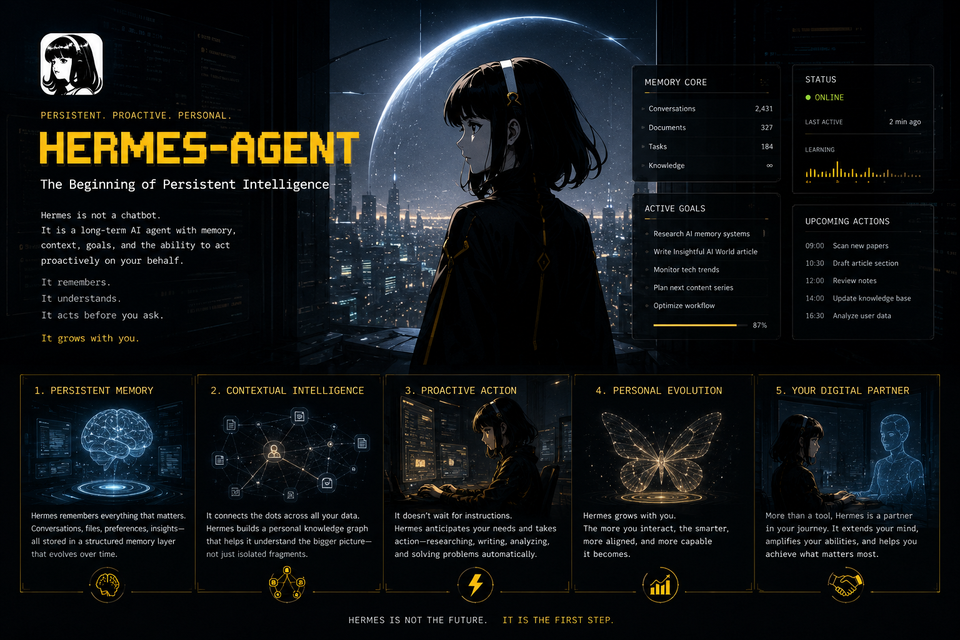
Developed by Nous Research, the project repeatedly emphasizes ideas like persistent memory, contextual accumulation, long-term interaction, evolving skills, and systems that “grow with you.” That phrasing matters more than it initially appears.
Growth implies continuity.
And continuity changes the structure of intelligence itself.
A system capable of accumulating memory over long periods of interaction behaves fundamentally differently from a system designed around isolated prompt-response cycles. Once memory becomes architectural rather than temporary, AI begins shifting away from transactional computation and toward something closer to longitudinal cognition.
This may eventually become one of the defining transitions of the entire AI era.
Because the future of artificial intelligence may not belong primarily to the systems that know the most.
It may belong to the systems that remember.
What Is Hermes Agent?
According to the official Hermes documentation, Hermes Agent is an open-source persistent AI agent framework designed around long-term contextual interaction rather than isolated conversations. Unlike traditional chatbot interfaces, Hermes attempts to maintain continuity across sessions through memory systems, autonomous workflows, persistent context management, and evolving behavioral adaptation.
The project is part of the broader research direction emerging from Nous Research’s GitHub organization, which has become increasingly influential within the open-source AI ecosystem through its work on language models, distributed AI research, and experimental agent architectures.
What makes Hermes particularly interesting is not merely the technical implementation itself, but the philosophical direction underlying the architecture. The project implicitly treats intelligence as something that unfolds across time rather than something that exists only inside isolated interactions.
That distinction may sound subtle.
It is not.
Because memory changes the nature of intelligence itself.
Human cognition cannot be separated from continuity. Memory is not merely a storage mechanism attached to intelligence; it is the structure that allows intelligence to persist coherently across time. Every form of human expertise — emotional, intellectual, strategic, creative — emerges from accumulated continuity. Without memory, even highly capable cognition becomes fragmented and shallow.
This is one reason researchers and philosophers have long explored the relationship between cognition and external memory systems. In his famous 1945 essay “As We May Think” by Vannevar Bush, Bush imagined systems capable of extending human thought through associative memory structures decades before modern computing fully emerged. Much later, philosophers Andy Clark and David Chalmers proposed the idea of the “Extended Mind” — the argument that cognition itself extends beyond the biological brain into tools, environments, and external systems.
Persistent AI may represent one of the first large-scale technological movements toward making that philosophical idea operational.
And that possibility carries implications far beyond chatbots.
Once AI systems begin accumulating years of contextual understanding, they stop behaving like isolated software tools and start behaving more like cognitive infrastructure layered continuously across human life. The interaction changes psychologically because continuity changes perception. Humans naturally anthropomorphize systems that exhibit memory, adaptation, responsiveness, and behavioral consistency over time.
The machine does not need consciousness to begin feeling relational.
Continuity alone may be enough.
This is why the rise of persistent AI matters.
Not because Hermes Agent itself is necessarily the final form of the technology. Not because the current generation of agent frameworks is complete. But because projects like Hermes quietly reveal the direction artificial intelligence may already be moving beneath the surface of the industry.
Toward systems that no longer merely generate responses.
But remember.